
Pope Leo XIV’s first encyclical, Magnifica humanitas, was published on Monday, May 25. Norwegian and international media have reported, among other things, that in paragraph 192 the Pope describes “just war theory” as “outdated.”
This is significant coming from an Augustinian like Pope Leo, given that the concept of just war dates back to St. Augustine in the 5th century. But what does it mean?

― We have to ask what the encyclical means by “war,” says Gregory Reichberg, philosopher and research professor at the Peace Research Institute Oslo (PRIO).
― My understanding is that what is outdated is the idea of a “war of choice” as a legitimate means of resolving disputes and restoring justice when a state believes its rights have been violated.
Reichberg explains that this view was common in the 19th century and early 20th century, in the absence of an international framework for dispute resolution.
Pope Pius XII, no pacifist, said in his radio message for Christmas 1944 that “the idea of war as an apt and proportionate means of solving international conflicts is now out of date.”
After the Second World War, this conviction was enshrined in the UN Charter of 1945.
― Armed force should no longer be used to resolve disputes between states, says Reichberg.
Pope John XXIII reiterated this message in 1963, citing “the terrifying destructive force of modern weapons” as the reason why “it no longer makes sense to maintain that war is a fit instrument with which to repair the violation of justice” (Pacem in terris, 127).
What is Magnifica humanitas?
- The first encyclical (teaching document) of Pope Leo XIV, signed on May 15 and published on May 25, 2026
- The title Magnifica humanitas means “magnificent humanity” and is taken from the opening words: “Humanity, created by God in all its grandeur, is today facing a pivotal choice” (MH, 1)
- Deals with artificial intelligence, digital technology, human dignity and social justice
- Develops Catholic social teaching in the face of the digital revolution
- Addresses topics such as algorithms, surveillance, human relations, work, disinformation, transhumanism and warfare
- Refers in several places to Rerum novarum by Pope Leo XIII and more recent social encyclicals
What is “war”?
Reichberg has done research on just war, and points out that the field does not revolve around a single monolithic theory.
He recalls a time when he spoke on the subject with reference to the war in Ukraine. A Catholic archbishop approached him afterward, saying: “Just war is a thing of the past, there is no return to that.”
― I was perplexed and said: “By my lights, the Ukrainians are waging a just defensive war against the Russian aggressors.” But he said: “That’s not war, that’s defense.”
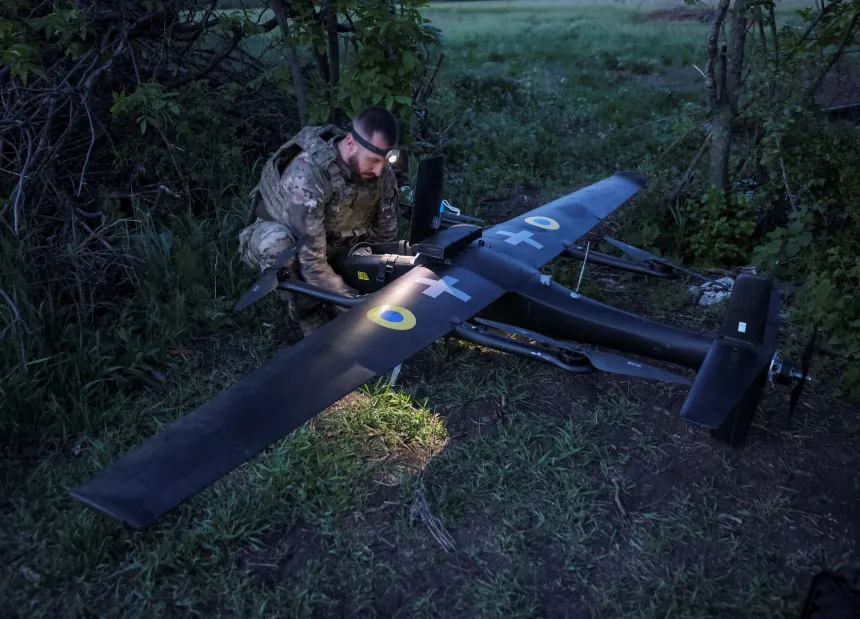
For the archbishop, “war” was synonymous with the 19th-century notion of a war of choice as a legitimate form of dispute resolution. Reichberg would not support implementing such an idea today, nor would most other scholars in the field.
He also believes that not everything referred to as “just war theory” can be reduced to this idea.
― Some versions of just war theory still speak that way, and certain states appeal to just war rationales for their use of force. This is what the encyclical rejects, and not the moral reflection on armed force as carried out by thinkers like Thomas Aquinas in what has come to be called the “just war tradition.”
Today, however, we are witnessing ... a troubling revival of war as an instrument of international politics, while the very ethical principles that had previously limited its use are being eroded.
Criteria for self-defense
Magnifica humanitas affirms the right to self-defense and invokes “the principle that armed force should be used only as a last resort” (MH, 197), which is one of the criteria for ius ad bellum ― just entry into war ― in just war theory.
It cannot, therefore, be these criteria that are outdated.
― We now have a framework for dispute resolution that should be used instead of armed force. But there are times when that framework fails, and armed force becomes necessary in self-defense. The criteria for this are a subject for reflection in just war theory, says Reichberg.
Humanity possesses far more effective and capable tools for ... resolving conflicts, such as dialogue, diplomacy and forgiveness. The use of force, violence and weapons reflects a relational poverty that always has disastrous consequences for civilian populations.
The encyclical also emphasizes that combatants and non-combatants must not be confused (MH, 199), which is one of the criteria for ius in bello ― justice in war.
Here, Reichberg points to a possible application of artificial intelligence:
― Just as AI can be used to identify and target combatants, it can also be used to identify and protect non-combatants on or near a battlefield.

AI for good or evil
Pope Leo warns that the use of artificial intelligence, particularly autonomous weapons systems, could “lower the threshold” for the use of military force.
Reichberg points out that the warning follows a clause acknowledging the value of the technology: “While AI can enhance the defense and protection of civilians, it can also lower the threshold for the use of force” (MH, 183).
― The use of AI in military operations is not necessarily wrong. The Church teaches that biological and nuclear weapons should not be used under any circumstances, but AI can be used for good or evil. It is used, for instance, in air defense systems, and it is a good thing that people are protected from incoming missiles.
While AI can enhance the defense and protection of civilians, it can also lower the threshold for the use of force, shield people from responsibility and foster a culture in which the enemy is reduced to a statistic and the victim to “collateral damage.”
He acknowledges that technology can lower the threshold for the use of force, because it creates greater distance and reduces the risk to one’s own military personnel.
This, he thinks, is not necessarily a bad thing in situations where force should be used.
― Should force have been used in Rwanda, when a million people were slaughtered? Nothing was done, because no country wanted to put its own personnel at risk. The threshold was simply too high. What if AI-enabled autonomous weapons had been used instead?

The encyclical does not reject all use of artificial intelligence in warfare, but sets out three requirements: the traceability of decisions so that accountability is not lost in the “machine,” human control over decisions regarding lethal force, and an international framework to curb the arms race and protect civilians (MH, 200).
Reichberg supports these requirements and states that AI systems can undermine the user’s critical judgment, making training and an understanding of system limitations absolutely essential. At the same time, he believes that “control” does not necessarily have to mean continuous human intervention.
Finally, he points out that a shared international framework for autonomous weapons is being discussed at the UN in Geneva, where the Holy See is also participating.
― It’s important that the Pope is pointing to these challenges that we need to think about over the coming years, he concludes.
Reichberg on just war in New York
Read more


